Ruth meets Boaz: Ruth 2
In Israel, the barley harvest began in the spring. The community in Bethlehem observed God’s law concerning harvesting: “When you reap the harvest of your land, do not reap to the very edges of your field or gather the gleanings of your harvest…. Leave them for the poor and the alien” (Leviticus 19:9-10).
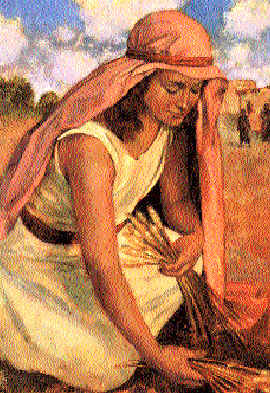 |
| "And Ruth the Moabitess said to Naomi, ‘Let me go to the fields and pick up the leftover grain behind anyone in whose eyes I find favor’" (Ruth 2:2). Illustration above by Dan Andreason; below by James Tissot |
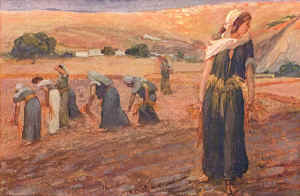 Ruth was both poor and an alien. She had few prospects in Judah, as Naomi had warned her. However, she was able to provide for Naomi and herself by working hard gleaning the grain left by the harvesters (Ruth 2:2). Ruth was both poor and an alien. She had few prospects in Judah, as Naomi had warned her. However, she was able to provide for Naomi and herself by working hard gleaning the grain left by the harvesters (Ruth 2:2). |
“As it turned out, [Ruth] found herself working in a field belonging to Boaz, who was from the clan of Elimelech” (Ruth 2:3). Boaz was a “man of standing [Hebrew: ‘ish gibbor chail, implying Boaz was physically impressive and had noble character]” (verse 1).
Boaz asked his foreman who the stranger gleaning in the field was. The foreman replied that she was the young woman who had accompanied Naomi back from Moab. Boaz then told Ruth to continue gleaning in his field, and helped her far beyond the demands of the law. He even ordered his harvesters to make Ruth especially welcome, enabling her to gather extra barley.
Ruth then asked Boaz, “Why have I found such favor in your eyes that you notice me — a foreigner?” (verse 10). Ruth’s expression about finding favor in Boaz’s eyes, used by her on three occasions (verses 2, 10, 13), was a culturally appropriate way of showing respect. Ruth thus displayed the type of attitude the apostle Paul later taught Christians to have, when he said, “In humility consider others better than yourselves” (Philippians 2:3).
