Showing posts with label Bees. Show all posts

Saturday, September 22, 2012

How bees decide

by David Catchpoole
Bee
When a hive gets too crowded, half the bees (together with the queen) swarm temporarily to a nearby tree to wait while several hundred go and scout for a new home. But how do they decide which site is best?
Photo Stockxpert
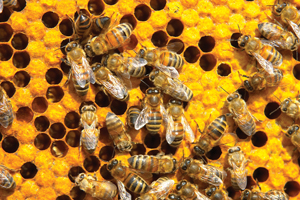
Bee hives
Photo by Amanda Greenslade
Bee
Researchers at Cornell University have now documented that the bees go through a group decision-making process, steadily narrowing down the options until a quorum develops.1,2 It’s long been known that honeybee scouts ‘waggle dance’ to report on food.3Researchers have now confirmed that they dance to report on real estate, too—the better the housing site, the stronger the waggle dance, and that prompts other scouts to visit the site.

Friday, September 21, 2012

Can it bee?


by Jonathan Sarfati
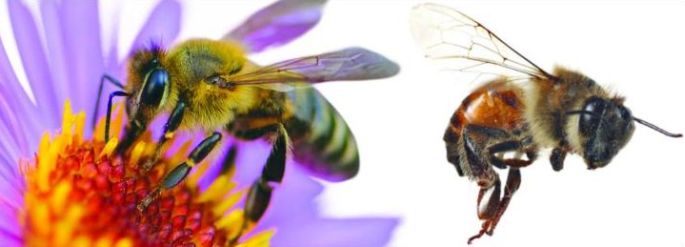
Honeybees fly with a remarkable agility that would be the envy of stunt pilots, yet their navigation ‘software’ is packed into a brain the size of a sesame seed. Now their techniques are being studied carefully at the All-Weather Bee-flight Facility at the Australian National University (ANU) in Canberra. There are plans to use them in miniature flying robotic spies and unmanned planetary exploration probes.1

How bees navigate

Bees have airspeed gauges; gyroscopes; a ‘compass’ that detects the polarization of sunlight; UV sensors to track the horizon to measure tilt; and two compound eyes, each with 7,000 hexagonal (six-sided) facets. These facets are windows to sub-eyes called ommatidia, which are tiny tubes containing their own lens and light-detecting cells. Each tube points in a different direction, enabling vision over a wide area. The hexagonal shape is ideal. It uses as little edge-cell material as possible (which is why the honeycomb is also hexagonal), has the least sharp corners needing less reinforcement, and is the most symmetrical structure. Such eyes are superb for detecting motion, since a small shift means different facets detect the image.

Bees outsmart supercomputers

by Carl Wieland
One of the most fiendishly complex mathematical computations is the so-called ‘Travelling Salesman Problem’. Given a list of locations (e.g. cities) and the distances between them, it involves finding the shortest possible route in which each location is visited only once. As the number of locations increases past anything more than a handful, the complexity of the problem increases dramatically, to staggering proportions.
‘In nature, bees have to link hundreds of flowers in a way that minimises travel distance, and then reliably find their way home—not a trivial feat if you have a brain the size of a pinhead! Indeed such travelling salesmen problems keep supercomputers busy for days.’—Professor Lars Chittka, University of London


Such computations “keep supercomputers busy for days”, says Professor Lars Chittka, from the University of London.1 Yet scientists from that university, using artificial computer-generated flowers, have found that bees learn to solve such problems, in effect, and extremely quickly.2 They are the first animals found capable of this—and they solve it for hundreds of locations.